
Payroll in Estonia 2026: 22% | 33% Rates & TSD Deadlines
Estonia payroll 2026 per EMTA: 22% income tax, 33% social tax, TSD by the 10th, data-based filing from 1 October. Employer cost example, EOR vs own OÜ.
Estonia payroll 2026 per EMTA: 22% income tax, 33% social tax, TSD by the 10th, data-based filing from 1 October. Employer cost example, EOR vs own OÜ.
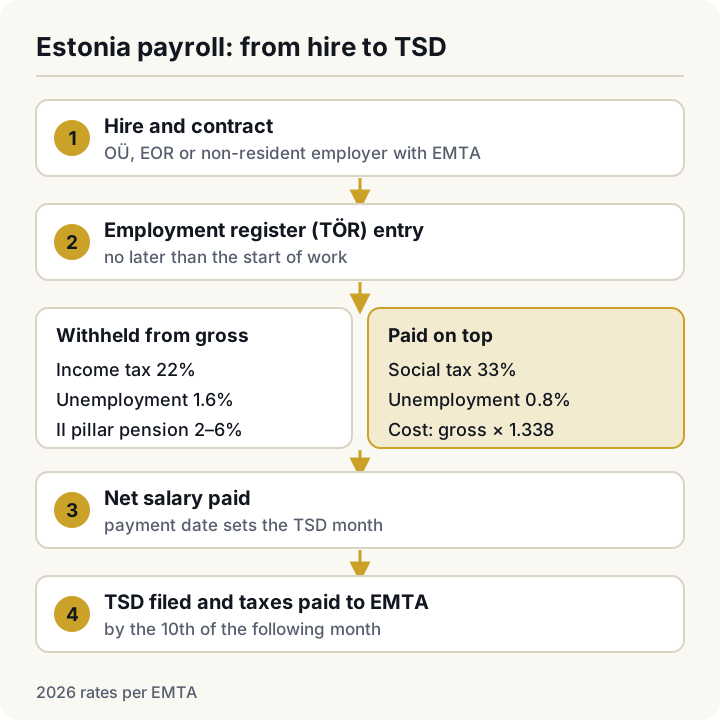
Payroll in Estonia for a foreign company in 2026 works like this: the employer records the employee in the employment register no later than the start of work, withholds 22% income tax, the 1.6% unemployment insurance premium and the 2–6% funded pension contribution, and pays 33% social tax plus 0.8% employer unemployment insurance on top. The TSD return is filed and the taxes are paid by the 10th of the month after the salary is paid (Estonian Tax and Customs Board, EMTA). An employee on €3,000 gross costs the employer €4,014 a month. From 1 October 2026, TSD moves to data-based filing straight from accounting software. Below: when you must register as an employer, the 2026 rates, deadlines, own OÜ vs EOR vs non-resident employer, a worked cost example and a 2027 plan.
Hiring in Estonia in Q4? A partner from our Estonia practice reviews your hiring set-up in 30–45 minutes, costs out each role and sends a written summary with next steps. Book the $99 strategy session, credited to the project → · Payroll services in Estonia
When the employee works in Estonia and the employer is foreign, EMTA requires the company to register as a non-resident employer. A company not entered in the Estonian commercial register completes this registration with EMTA before starting activities.
A non-resident employer's obligations, per EMTA:
Two questions we check before the hire. First, for an employee working remotely from another country, the Estonian Social Insurance Board or the competent authority of another EEA state decides where social security is paid, evidenced by an A1 certificate. Second, whether the employee creates a permanent establishment of your company in Estonia. That drives corporate tax.
EMTA publishes the 2026 rates on its Tax rates page. They are the same for a resident company and a non-resident employer.
| Item | 2026 rate | Who bears it |
|---|---|---|
| Income tax | 22% | Withheld from salary |
| Basic exemption | €700 a month (€8,400 a year); €776 at pensionable age | Applied on the employee's written application |
| Social tax | 33% | Employer, on top of salary |
| Minimum social tax obligation | Base €886; minimum €292.38 a month | Employer |
| Unemployment insurance | 1.6% employee, 0.8% employer | Withheld / paid |
| Mandatory funded pension (II pillar) | 2%, 4% or 6%; default 2% | Withheld from salary |
| Minimum wage from 01.04.2026 | €946 a month, €5.67 an hour | Government Regulation No 36 of 23.03.2026 |
| Employee health expenses | Up to €400 a year tax-free | Employer |
| Corporate income tax | 22/78 on distributed profit | Company |
| VAT | 24% standard rate | Company |
The key 2026 change: the basic exemption no longer depends on income. Every employee who applies gets €700 a month at any salary level. In 2025 it was up to €654 and shrank as income rose.
TSD is filed by the 10th of the month following the month of payment, and the taxes must reach EMTA's account by the same date. Estonia taxes payroll on a cash basis: the payment date sets the tax month.
In practice:
From 1 October 2026 TSD becomes data-based. Accounting software sends salary payment data to e-MTA over a machine-to-machine interface, EMTA builds the return and the accountant approves it. Annexes 1 and 2 are replaced by a single payments view covering residents and non-residents, and file uploads move to the XBRL GL format; the previous XML format stops being valid. e-MTA keeps accepting the current CSV file as a transitional solution until the end of 2027. Before the next TSD deadline, check whether your accounting software supports the new interface.
There are three ways to employ someone in Estonia. The choice decides who the employer is for EMTA, who files TSD and how fast you start.
| Own Estonian OÜ | EOR (Employer of Record) | Non-resident employer | |
|---|---|---|---|
| Legal employer | Your OÜ | Estonian provider company | Your foreign company |
| Registration | OÜ in the commercial register, then TÖR | Provider registers the employee | Non-resident registration with EMTA, then TÖR |
| Who files TSD | Your accountant | The provider | Your accountant or representative |
| Best fit | Growing Estonian team, EU banking and VAT needed | One or two hires, fast start | A few employees, no Estonian business |
| Watch for | 22/78 corporate tax only on distribution | Provider margin, IP assignment in the contract | Permanent establishment risk |
In our experience EOR suits the first hire. Your own OÜ usually wins once the Estonian team grows or EU revenue appears. The answer depends on your model; incorporation and bank timelines depend on the bank and its checks.
Employer cost equals gross salary × 1.338 (33% social tax plus 0.8% unemployment insurance). Net pay equals gross minus 1.6% and the pension contribution, minus 22% income tax on the amount left after those contributions and the basic exemption. The employee's unemployment premium and pension contribution are deducted from taxable income (EMTA; Estonian Ministry of Finance).
Estonian-resident employee who applied for the basic exemption, 2% pension rate, 2026:
| Gross monthly salary | €2,000 | €3,000 | €5,000 |
|---|---|---|---|
| Social tax 33% | €660.00 | €990.00 | €1,650.00 |
| Employer unemployment insurance 0.8% | €16.00 | €24.00 | €40.00 |
| Total employer cost | €2,676.00 | €4,014.00 | €6,690.00 |
| Employee unemployment insurance 1.6% | €32.00 | €48.00 | €80.00 |
| Funded pension 2% | €40.00 | €60.00 | €100.00 |
| Taxable base (after €700 exemption) | €1,228.00 | €2,192.00 | €4,120.00 |
| Income tax 22% | €270.16 | €482.24 | €906.40 |
| Net pay | €1,657.84 | €2,409.76 | €3,913.60 |
For an employee who is not tax-resident in Estonia the basic exemption follows separate rules, which EMTA describes separately for residents and non-residents. We calculate those cases per employee.
As of 28.09.2026 EMTA's rates page covers 2024–2026 and has no 2027 rates yet. Build the 2027 model on 2026 rates and re-check in December.
Five points for the autumn hiring plan:
Social tax of 33% and employer unemployment insurance of 0.8% on top of salary. Income tax of 22%, employee unemployment insurance of 1.6% and the 2–6% pension contribution are withheld. Everything is reported on TSD and paid by the 10th of the following month.
Yes. The company registers with EMTA as a non-resident employer, records the employee in the employment register and files TSD itself. The alternative is an EOR provider.
By the 10th of the month after the month in which salary is paid. From 1 October 2026 the data can be sent straight from accounting software.
€4,014 a month for the employer. A resident employee with the basic exemption and a 2% pension rate takes home €2,409.76.
It registers the employer and employees, runs monthly payroll, files TSD, pays taxes on time and keeps the books. We add entity choice, banking and the corporate tax side under the same partner.
INNOVA's Estonia practice has been partner-led since 2017. We register your OÜ or non-resident employer status, record staff in TÖR, run payroll and TSD, bookkeeping and banking. Payroll in Estonia starts from US$600 a month depending on turnover and transaction volume; the exact fee comes in writing after a 30-minute call.
Why clients work with us:
Payroll in Estonia → · $99 strategy session · Doing business in Estonia · Contact us
Related: Estonia e-Residency: the complete guide, EU customs reform 2026 and IOSS.
Sources: EMTA, Tax rates (2024–2026); EMTA, Non-resident as an employer; EMTA, Submission of declaration form TSD; EMTA, Employment registration; EMTA, Social tax; EMTA, Income tax and basic exemption; EMTA, Income from employment; Estonian Ministry of Finance, Taxes; Pensionikeskus, II pillar contributions.
For information only; rates checked against EMTA and the Estonian Ministry of Finance on 28.09.2026. The final burden depends on the employee's residency, the contract and your company structure.
This material is for general information only and does not constitute legal or tax advice. Accurate as of the publication date.