
EU Customs Reform 2026 → €2 Handling Fee & €3 Duty per Item
EU customs reform in force since 20.09.2026: a €2 per-item handling fee is set, expected from November, on top of the €3 duty. What to recalculate now.
EU customs reform in force since 20.09.2026: a €2 per-item handling fee is set, expected from November, on top of the €3 duty. What to recalculate now.
The EU customs reform is adopted and in force: Parliament and Council signed the new Union Customs Code (Regulation 2026/2108) on 16 September 2026, it appeared in the Official Journal on 19 September, and has been in force since 20 September. On 21 September the Commission set the new handling fee at €2 per item sold in distance sales and expects it to start in November 2026. The fee comes on top of the €3 duty per item on parcels up to €150, which has applied since 1 July 2026. Next on the timeline: from 21 September 2027 the seller or platform becomes the "importer for distance sales", and from 1 July 2028 e-commerce imports go through the EU Customs Data Hub. Before November, recalculate unit economics and choose your route: IOSS or your own EU company.
Shipping to EU customers from China, Türkiye, the UAE or the US? An Estonia-practice partner reviews your parcel flow, IOSS and the Estonian OÜ option in 30–45 minutes and sends a written summary with next steps. Book the $99 strategy session, credited to the project →
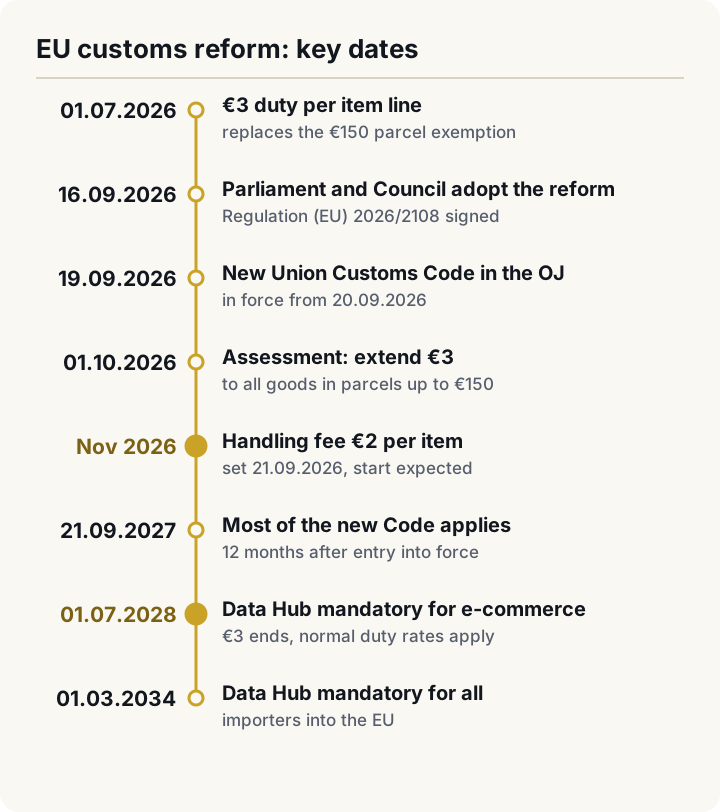
The reform creates the EU Customs Authority (EUCA, Lille) and the EU Customs Data Hub. Most of the new Code applies 12 months after entry into force, from 21 September 2027.
| Date | What changes | Source |
|---|---|---|
| 01.07.2026 | €150 duty exemption ends; temporary €3 per item applies | Council Regulation (EU) 2026/382 |
| 16.09.2026 | Parliament and Council adopt and sign Regulation 2026/2108 | Regulation 2026/2108 |
| 19.09.2026 | New Union Customs Code published in the Official Journal; in force from 20.09.2026 | Official Journal; Commission, IP/26/1904 |
| 21.09.2026 | Commission adopts Delegated Regulation C(2026) 6694: handling fee of €2 per item | Delegated Regulation C(2026) 6694 |
| 01.10.2026 | Commission starts monthly checks for trade diverted away from IOSS and may propose extending €3 to all goods in parcels up to €150 | Regulation 2026/382, Art. 3 |
| November 2026 (expected) | €2 handling fee starts: 10 days after the delegated regulation enters into force | Regulation 2026/2108, Art. 20 and 287(4); Commission |
| 21.09.2027 | Most of the new Code applies; the old Code (Regulation 952/2013) is repealed | Regulation 2026/2108, final article |
| 01.07.2028 | Data Hub mandatory for e-commerce; the temporary €3 ends and normal duty rates apply | Regulation 2026/382; Commission |
| 01.03.2034 | Data Hub mandatory for all importers | Commission |
The €3 end date can move: by 1 December 2027 the Commission assesses whether the Data Hub will be ready and may propose an extension if it is late (Art. 3 of Regulation 2026/382).
The fee is €2 per item and is charged on release for free circulation of goods sold in distance sales (Art. 1 of Delegated Regulation C(2026) 6694; Art. 20(2) of Regulation 2026/2108). The fee applies at any parcel value: the Commission's explanatory memorandum states that distance sales above €150 are also subject to it. The Commission based the amount on customs costs for data checks, risk analysis, controls and infrastructure.
The start sequence: the regulation enters into force on publication in the Official Journal, provided Parliament and Council raise no objection within 30 days of notification (Art. 282(7) of Regulation 2026/2108), and applies from the 10th day after entry into force. The Commission expects the start in November 2026. As of 28.09.2026 the act has no Official Journal reference yet.
The fee is paid by the customs debtor, at least monthly (Art. 20(5)). Until the "importer for distance sales" rules apply, that is the declarant: typically the IOSS holder or an indirect customs representative. The consumer is never the debtor of the fee (recital 80). Goods released from a customs warehouse for distance sales will get a lower fee from 1 July 2028 (Art. 20(4)); the Commission has not yet set that amount.
Volumes are already falling. Per the Commission, the EU imported 60% fewer items sold in distance sales in July 2026 than in July 2025; the Commission adds that one month of data is too early for conclusions (SWD(2026) 283).
The €3 duty is charged per customs declaration line, whatever the number of units in that line, provided the goods in the declaration total no more than €150. Grouping goods of different codes into one line is barred while €3 applies (amended Art. 228(1) UCC-IA). Per the Commission guidance, €3 covers distance sales under any VAT route: IOSS, special arrangements or standard VAT.
The number of lines depends on the declaration type. Commission example: a €140 parcel with three women's suits of different materials.
Under the new Code, the "importer for distance sales" is either the person supplying the goods or the platform facilitating the sale (Art. 5(14) of Regulation 2026/2108). The Commission sums it up this way: non-EU platforms and sellers are responsible for customs formalities and duty on goods they sell into the EU. Non-compliance brings fines, loss of customs privileges and access restrictions. These rules sit in the main body of the Code and apply from 21 September 2027, with some distance-sales provisions from 1 July 2028.
IOSS (Import One-Stop Shop) lets you charge EU VAT at checkout and file one monthly return by the end of the following month. With IOSS the release declaration can be lodged in any Member State; without it, in the Member State of destination.
| IOSS from outside the EU | Own EU company (Estonian OÜ) | |
|---|---|---|
| Intermediary | Required. Exception: a seller from a country with a VAT mutual-assistance agreement (e.g. Norway) shipping only from that country | IOSS registration in the country of establishment, no intermediary |
| €3 duty and €2 fee | Payable | Payable on parcels shipped to consumers from third countries; from 01.07.2028 a lower fee for a customs warehouse for distance sales |
The answer depends on volume, basket size, declaration lines per parcel and where stock sits. VAT schemes are covered in EU OSS and IOSS for non-EU sellers.
It is the VAT number for the IOSS scheme covering parcels up to €150. It stays useful: VAT is collected at checkout and the declaration can be lodged in any Member State. The €3 duty and the €2 fee apply with or without IOSS.
€3 per declaration line in the parcel, from 1 July 2026 to 1 July 2028. Normal duty rates apply after that unless the Commission proposes an extension.
€2 per item sold in distance sales, set by the Commission on 21.09.2026. It applies from the 10th day after the delegated regulation enters into force; the Commission expects November 2026. The declarant pays, never the consumer.
IOSS with an intermediary is enough for a non-EU seller. An EU company pays off with EU stock, B2B sales or an EU bank.
INNOVA's Estonia practice has been partner-led since 2017: OÜ, VAT, OSS and IOSS, banking and bookkeeping under one named partner. Partner reply within 24 hours; price fixed after a 30-minute scoping call.
Book the $99 strategy session → · Estonia e-commerce set-up · Contact us
Sources: Commission, IP/26/1904; Commission, EU Customs Reform; Delegated Regulation C(2026) 6694 (€2 fee); Commission, SWD(2026) 283; Commission €3 guidance; Regulation (EU) 2026/2108; Council Regulation (EU) 2026/382; OSS portal, IOSS registration; OSS portal, returns.
For information only; primary sources as of 28.09.2026. Dates and amounts depend on Commission acts and customs practice.
This material is for general information only and does not constitute legal or tax advice. Accurate as of the publication date.